

We are all trying to figure out the implications of AI for jobs and careers. Since there was limited to no information for Finance, I started looking at job ads and following influencers for product and engineering roles to understand the dynamics. The themes were consistent: AI skills command a premium between 15 to 30%. However, I was not seeing anything like that in the finance ads.
Why might product / engineering roles be ahead of the curve?
The disruption is a lot more prominent in product management and engineering, and the reason is not that those functions move faster. The AI toolkit was built with them as the ideal stakeholder in mind. Other functions only started to see real utilisation this year.
OpenAI published its own internal numbers in June. Their engineers moved to agentic tools as their primary way of working by December 2025. Legal, finance and recruiting crossed the same line around April 2026, four months later, although once they started the shift ran faster. This is inside the company that builds the tools, where there is no procurement cycle, no security review and no licence to argue for. Finance was still four months behind engineering. Their own explanation for it is the one above: the tool began with developers, who were the natural audience for what started as a coding product.
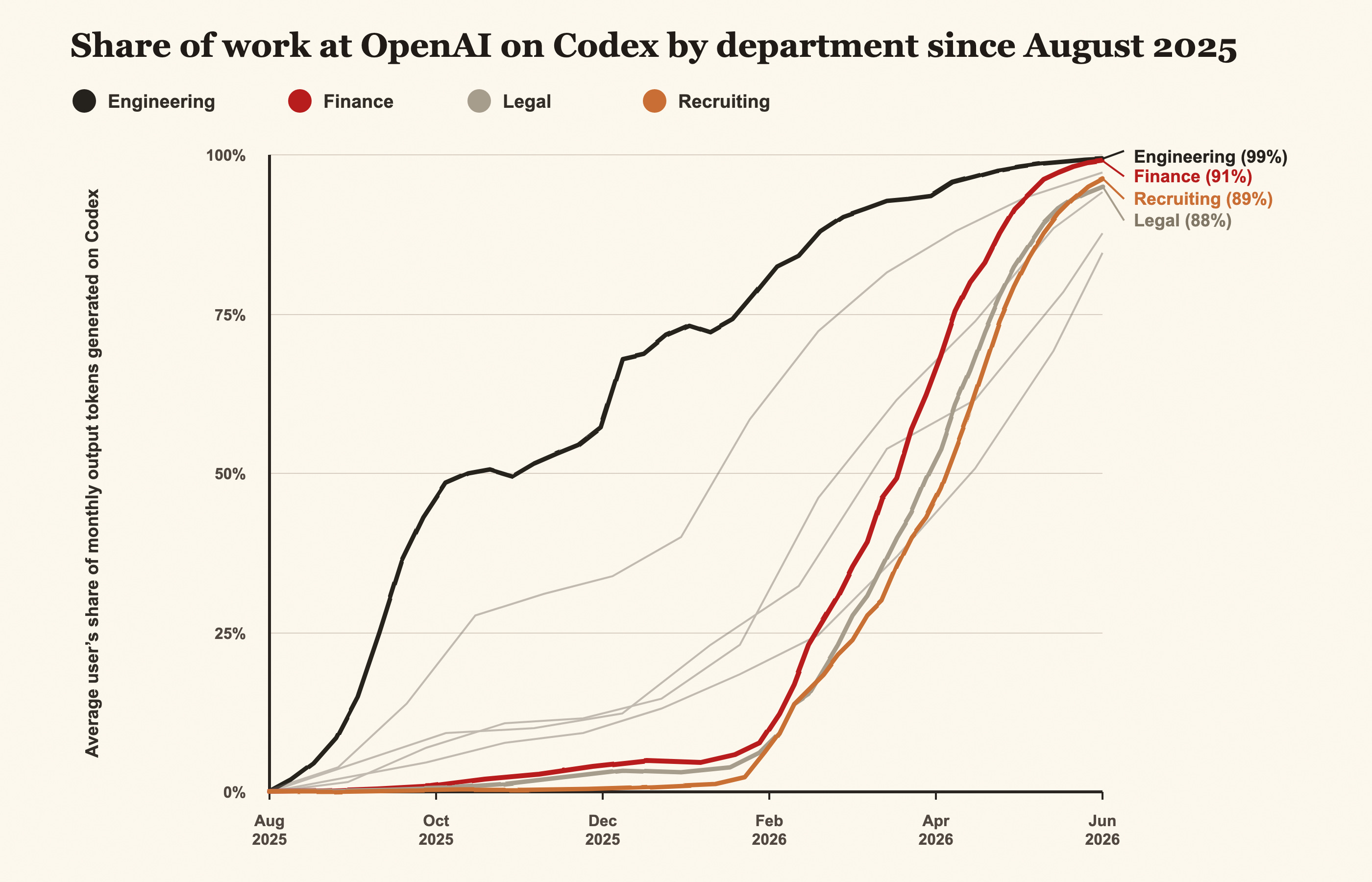
Source: OpenAI, "How agents are transforming work", 25 June 2026.
That sequencing matters more than it looks. Most tech companies have understood that they need to be ahead on AI. They are starting with product and engineering first, because that is who the tools were built for. After that it really comes down to the CXOs and their willingness to drive adoption across functions.
What do the job advertisements actually say?
I have been tracking finance postings across the public job boards of 307 tech companies. Among the companies whose full posting text is available, 72.8% mention AI somewhere in the ad. Finance is not behind on asking.
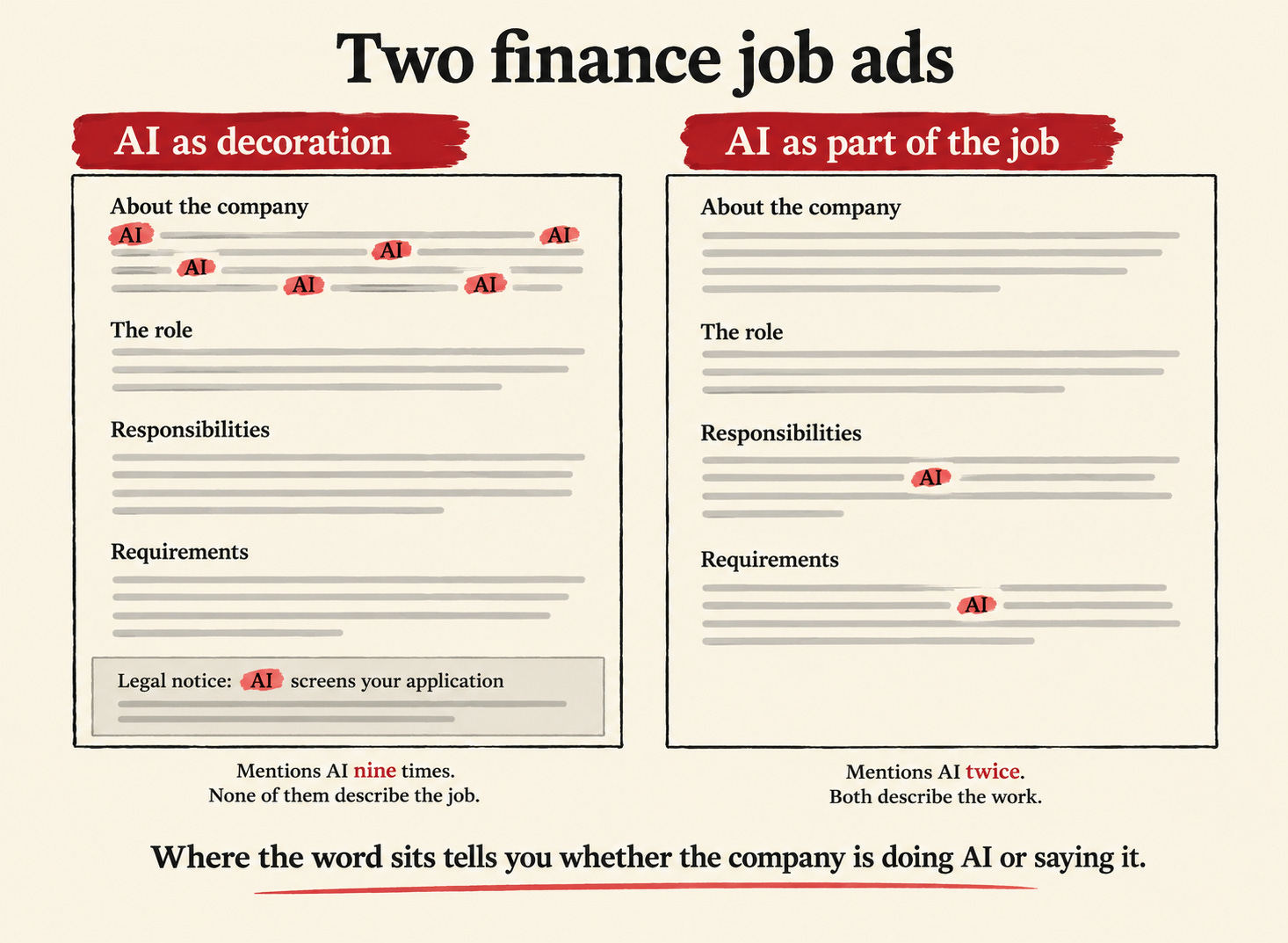
The gap is in what is being asked for. Running the same parser over product management postings from the same companies in the same week, about half of the AI-mentioning product ads put AI in the responsibilities section, against less than a third of the finance ads. The requirements sections are nearly identical. Finance job descriptions describe AI as a qualification. Product job descriptions describe it as a job.
Also unlike product managers, there is no such thing as an AI Finance Manager. I have been tracking finance postings across the public job boards of 307 tech companies, which skews to venture and growth-stage tech.
What does it mean for interviewing?
A company can be genuinely ahead on AI in product and engineering and still have a finance function where nothing has happened. That is the opportunity.
If you are coming to the interview and saying you use AI as a chat function, you have already lost the AI value proposition point. Chat is something that a person who is not even working in finance, or engineering, or in tech can do. It is super, super basic, and it does not give confidence that you are ahead of the curve.
That is how people are winning these interview races right now. Some people are able to prove their ability to adopt AI natively, and there are people building real expertise.
What happens next?
Over a period of time companies will start to become more sophisticated in their job descriptions, and you can see that that is how product management went. Currently the finance job descriptions are a little bit lighter. They will become stronger and more fine-tuned in terms of specific skills as well as tools, instead of just saying build with AI. Because of the scarcity of talent, the people who were first keeping up with these tools and are now developing real proficiency in them will be able to command a premium.
Over a period of time that scarcity will go away, as more and more people learn, and a baseline expectation will be set for these skills. They will become like Excel, or financial modelling, or SQL. SQL is a good example in finance. Finance managers and finance teams did not even have SQL seven or eight years ago, and as finance tools got more data-intensive it became a very strong enabler. Now most people are expected to have it, and mostly nobody is paid extra for it.
However, in the near term I do expect a distinct premium for AI skills and that is an argument for moving now rather than later.
In the next few articles, I will recommend some resources that I have found to be particularly helpful in learning AI for Finance.
The shift from listing AI as a skill to using it as part of the actual finance workflow is important. As adoption moves beyond basic assistance, finance teams will need to think more about how AI changes the work itself.