

AI has commoditized analysis and that has led to Business Leaders becoming more liberal with their questions and the pace at which insights can be generated through AI. Leaders want more analysis and problems to be solved more quickly. A cohort model that took a week now takes a few hours, so why can you not solve 100x more problems? Might look like a fair question, but it is not.
While analysis has gotten easier and faster, some things have become more challenging. I would argue that two weeks came down to two hours only because you are not doing some of the other tasks, problem definition, auditing, scaling, as well as you could be. The time to analysis compressed. However, the work around it has not disappeared and might have gotten more complicated: deciding which problem to solve, defining the problem, and auditing.
I have seen first hand that leaders have already burned their hands in many cases. They took AI outcomes that were not audited sufficiently, drew the wrong conclusions, communicated the insights, and lost face. This has led to a more realistic tempering of their expectations to what is achievable. There is time being saved. However, the question is: Where should the freed time go?
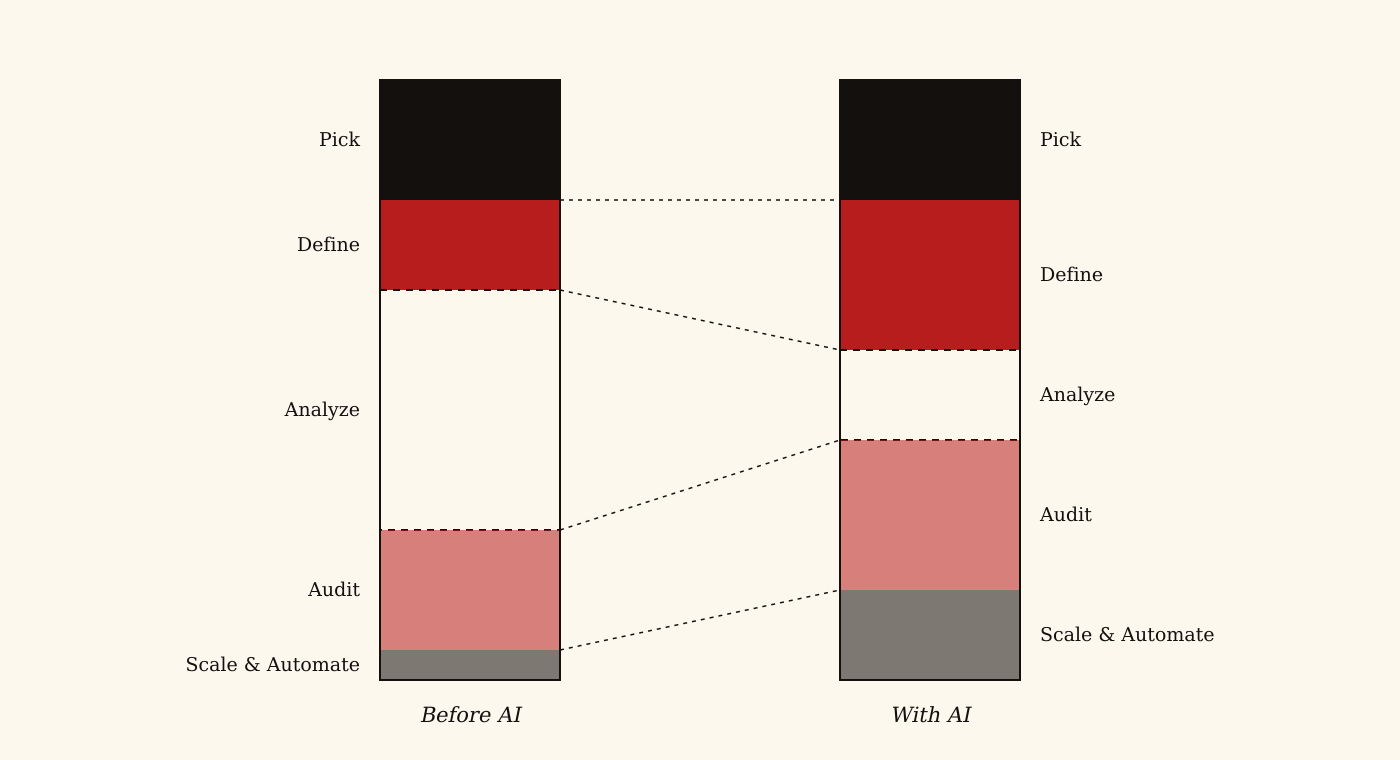
An ideal sequence would be »»»» pick the right problem to pursue »»»» define the problem »»»» run the analysis »»»» audit it effectively »»»» and then scale and automate what you learned.

AI has compressed the middle step. The time it frees needs to go to the steps around it: defining the problem better so that AI can absorb it, auditing the output, and converting the analysis into something your team can reuse. If time still permits, expand the number of problems. People sometimes make the mistake of taking that path first, working on more problems and skipping the other tasks, and that is the core challenge in the AI era.
This part of the newsletter covers the first two steps: Picking the right problem and Defining the problem well.
How do you pick the right problems?
This is not new. It is the same discipline as before AI came into play: identifying problems that are worthy of your time and the ROI. I always tell my team to think through three questions.
Am I the right person to solve this?
If you have received a problem, are you the right person to solve it, or could you delegate it to a team member better placed?
Has somebody already solved it?
If you are the right person, has one of your peers already solved it? Take advantage of that before building anything.
Is it worth your time?
Is this the highest-impact problem you could work on within your constraints and against the list of problems you already have?
Someone has to gate the flow. Usually that is you: the one running the analysis, the manager of the team, or the director or VP setting the tone for the context the team operates in.
Is the gate temporary or permanent? Only time can tell. People must have had the same challenge with Excel modelling once, whether they could trust it, and over a period of time enough trust built up that it could be managed. AI workflows are still in early stages of development. We need the gate until we can be confident in not only the robustness of the workflow, but the capacity of people and stakeholders to understand the challenges.
How do you define a problem so AI can absorb it?
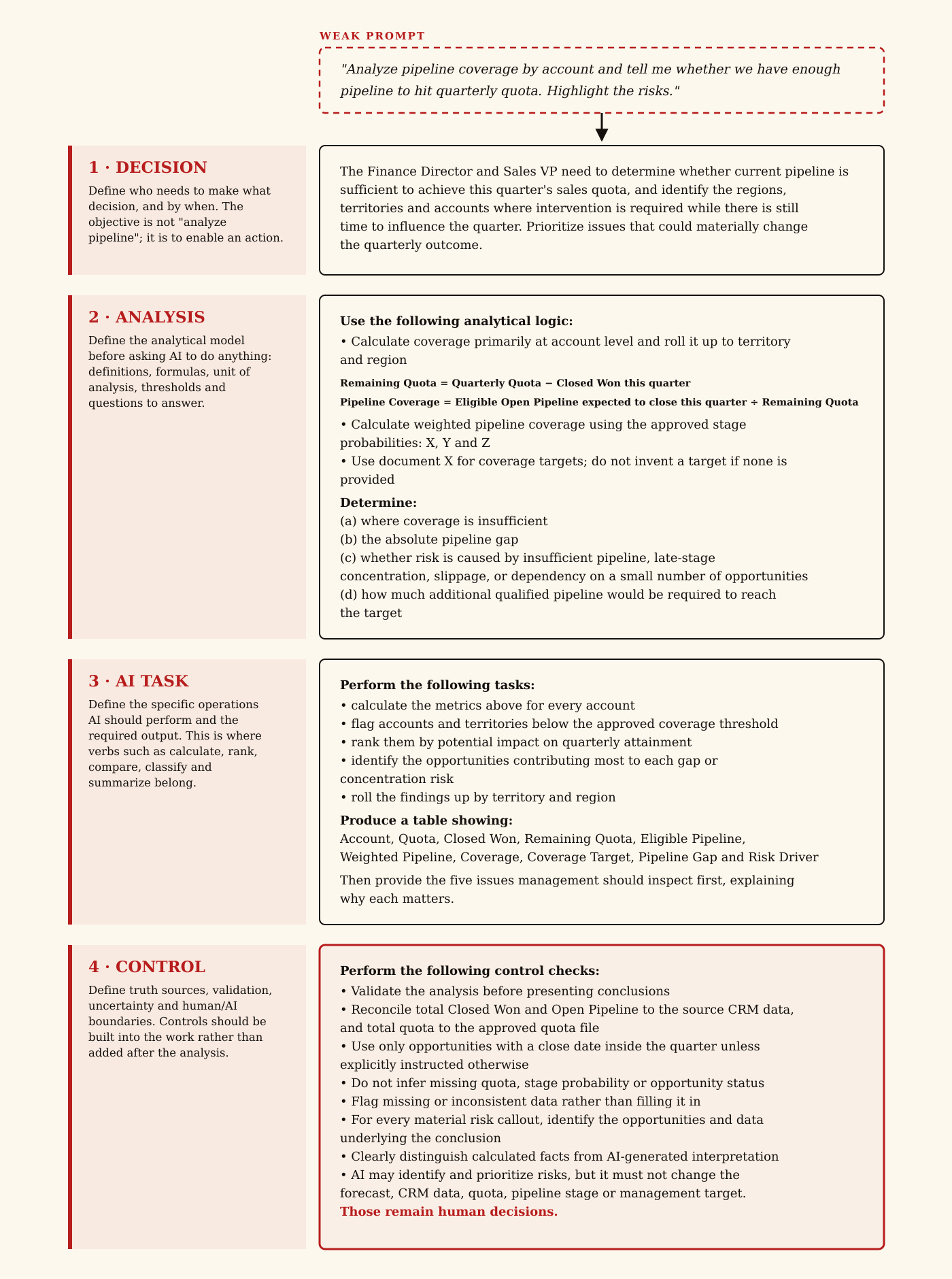
A lot of focus today goes into building prompts and agents, and very little into defining problems well. Finance can take inspiration from product management here. Most prompts look like a task: “Do variance analysis”, “Create a deck that does….”, and “Summarize XYZ”. The task is not the problem.
Take a request like: analyze pipeline coverage by account and tell me whether we have enough pipeline to hit quarterly quota.
There is nothing obviously wrong with it. That is the problem. AI has to fill in almost everything that matters.
What does coverage mean?
At what level should it be calculated?
Which opportunities are eligible?
Should open pipeline be weighted, and at what probabilities?
What counts as insufficient?
Which data is authoritative?
Can it infer a missing assumption, or should it stop and flag it?
I use a 4-part structure for this, and I call it a decision spec. The inspiration for starting with decision-first comes from Google’s decision-intelligence work, and the analysis and task framing from Google’s ML problem-framing guidance. Google has done a lot of incredible research in this area. The Control layer is my addition to ensure the framework is suitable for Finance and Strategy roles. The first three parts define what you are delegating. Control defines what you are not.
What I would leave you with
When analysis gets cheap, the critical thing is to protect the time investment. Getting better at problem definition, at auditing, and at working on the right problems matters more than ever before. Everyone knows the analysis has gotten cheaper, and the expectation will be simple: the cohort model takes a few hours instead of a week, so why are you not doing 100x? The honest answer is the work around the analysis. More importantly, it is critical not to compromise on the credibility of the analysis, and the work around it helps you do that.
Part 2 covers the other side of the sequence: auditing the analysis, and scaling and automating it, so you can continue to scale the wins.
Appendix (Full Prompt ready to Copy)
Decision.
The Finance Director and Sales VP need to determine whether current pipeline is sufficient to achieve this quarter’s sales quota, and identify the regions, territories and accounts where intervention is required while there is still time to influence the quarter. Prioritize issues that could materially change the quarterly outcome.
Analysis.
Use the following analytical logic:
Calculate coverage primarily at account level and roll it up to territory and region
Remaining Quota = Quarterly Quota − Closed Won this quarter
Pipeline Coverage = Eligible Open Pipeline expected to close this quarter ÷ Remaining Quota
Calculate weighted pipeline coverage using the approved stage probabilities: X, Y and Z
Use document X for coverage targets; do not invent a target if none is provided
Determine:
(a) where coverage is insufficient
(b) the absolute pipeline gap
(c) whether risk is caused by insufficient pipeline, late-stage concentration, slippage, or dependency on a small number of opportunities
(d) how much additional qualified pipeline would be required to reach the target
AI Task.
Perform the following tasks:
calculate the metrics above for every account
flag accounts and territories below the approved coverage threshold
rank them by potential impact on quarterly attainment
identify the opportunities contributing most to each gap or concentration risk
roll the findings up by territory and region
Produce a table showing: Account, Quota, Closed Won, Remaining Quota, Eligible Pipeline, Weighted Pipeline, Coverage, Coverage Target, Pipeline Gap and Risk Driver.
Then provide the five issues management should inspect first, explaining why each matters.
Control.
Perform the following control checks:
Validate the analysis before presenting conclusions
Reconcile total Closed Won and Open Pipeline to the source CRM data, and total quota to the approved quota file
Use only opportunities with a close date inside the quarter unless explicitly instructed otherwise
Do not infer missing quota, stage probability or opportunity status
Flag missing or inconsistent data rather than filling it in
For every material risk callout, identify the opportunities and data underlying the conclusion
Clearly distinguish calculated facts from AI-generated interpretation
AI may identify and prioritize risks, but it must not change the forecast, CRM data, quota, pipeline stage or management target. Those remain human decisions.