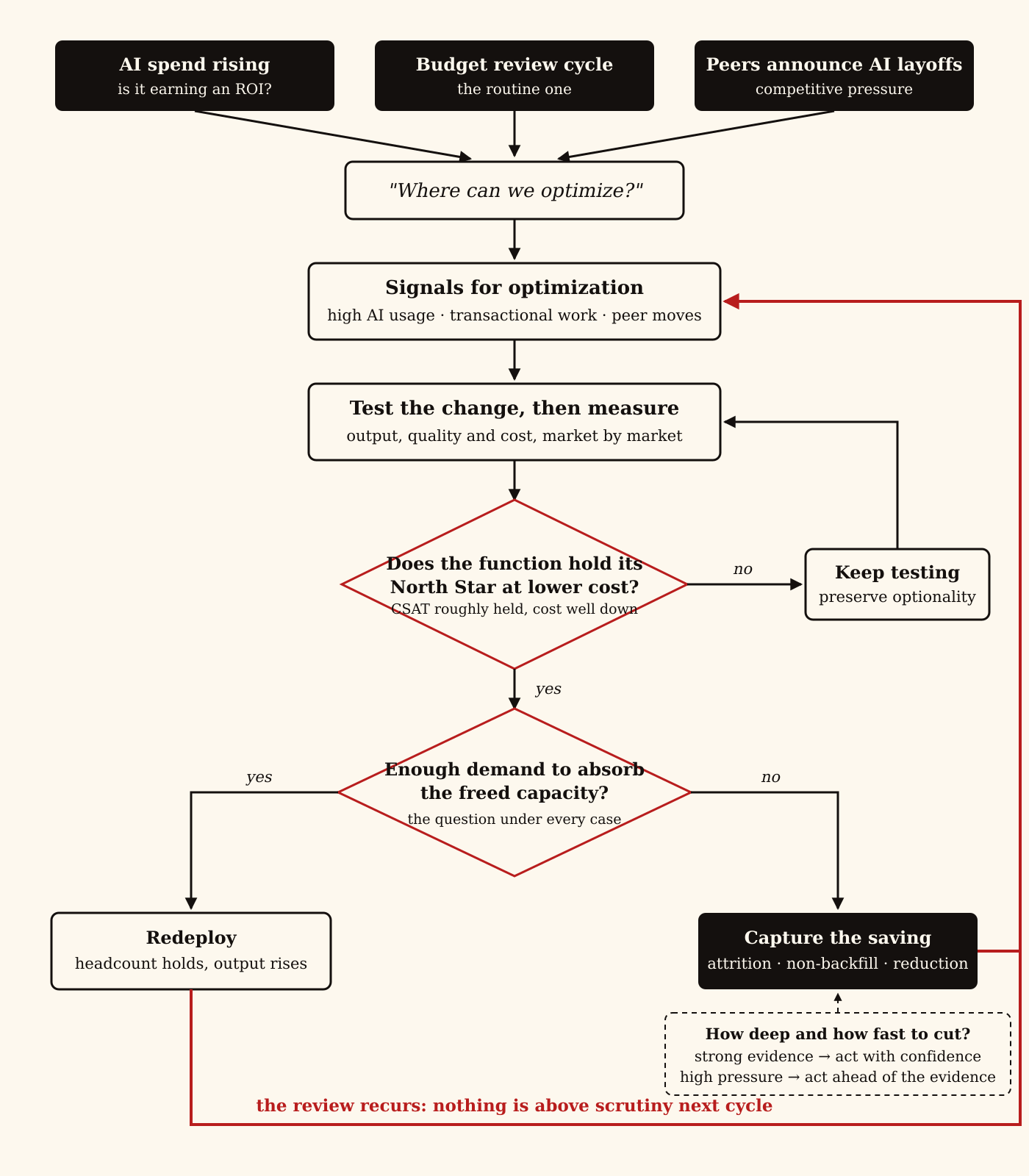
For most companies, the AI budget is up again this year. Most of the increase is from tokens. And somewhere in the planning cycle (or even outside of that), many senior leaders are asking themselves: how are we funding this or getting an ROI? How do we inform our capital-allocation decisions in this environment.
How do companies decide where to look?
All companies are different and the approach varies based on size and culture. However, I will share how I have seen this happen front and center. Three flags come up again and again in various discussions.
Token consumption is the first. If most of the incremental AI budget sits with one function, the question writes itself: are there productivity gains, and where are they showing up? Usage is not impact. However, it is where the scrutiny starts.
The nature of work is the second. Transactional, rules-based work with little need for long-term context or judgment gets examined first. Relationship-heavy, judgment-heavy work is harder to automate.
The third flag is peer pressure: Folks underestimate how much peer pressure companies face and how that gets compounded by Wall Street / shareholders. You just have to see quarterly analyst call transcripts to see pointed questions like “Intuit just laid off people in X department, what opportunities do you see?”. Companies are closely watching what their peers have automated and which functions they have reduced. Peer behaviour proves nothing about your own productivity. However, it increases a company’s conviction.
How is assessment done?
I have been in these rooms and the pressure to show results is high. Many companies are running multiple pilots to test whether there are any savings without compromising on the North Star metrics. For example, whatever the function’s North Star is, customer satisfaction, roadmap delivery, forecast quality, can it hold at roughly that level while the cost falls materially? If customer satisfaction drops from 95 to 90 while the cost of the function falls 20%, that is a trade leadership will seriously consider. Not perfect automation. An acceptable outcome at a materially lower cost.
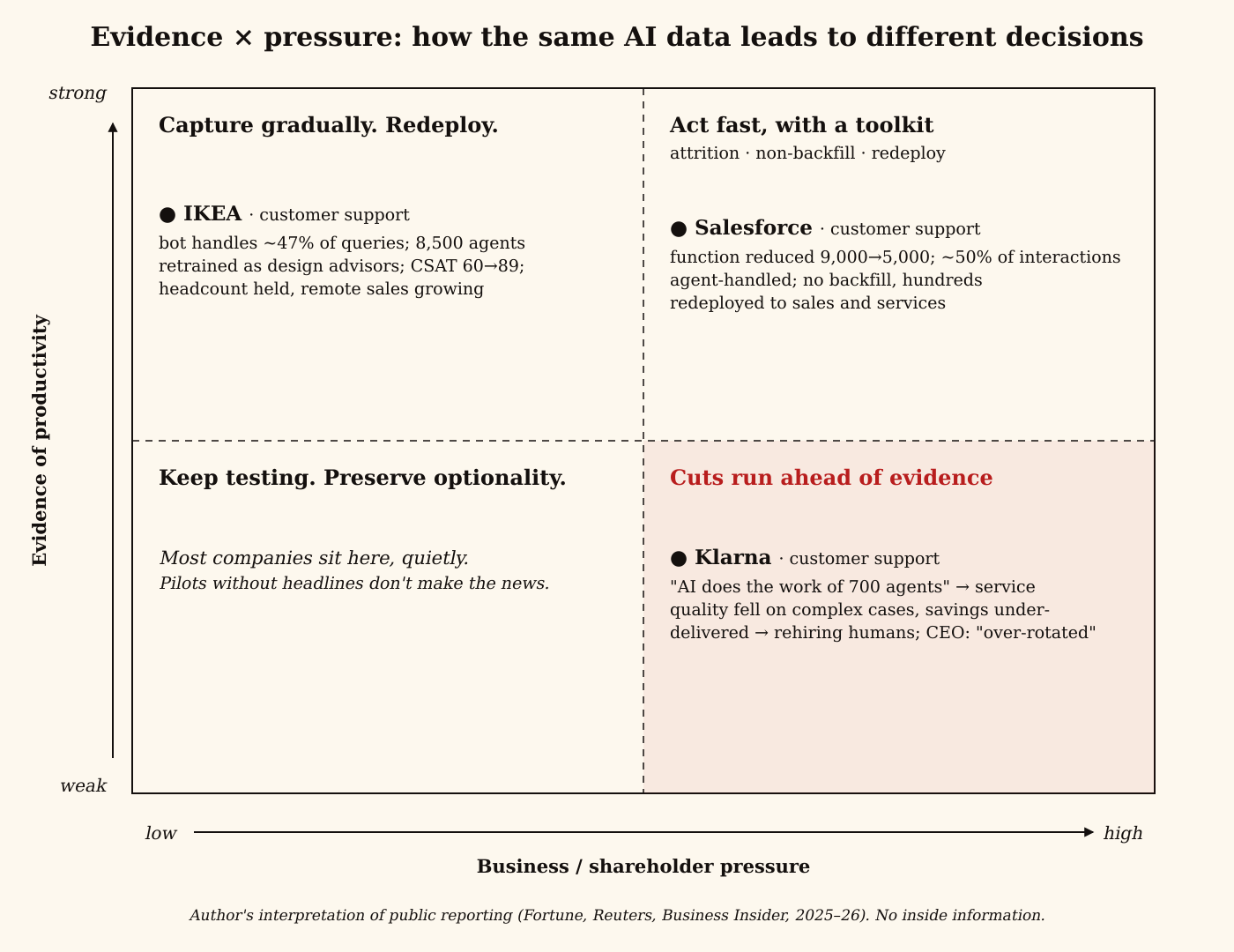
Sometimes, the companies are more aggressive and willing to go deeper in HC cuts, beyond what the pilot results showed, and it comes with its own risks. Case in point: Klarna had to reassign engineers and marketers to customer support after its AI bet went too far (Business Insider). This is what happens when you do not have any margin of safety and want to showcase your aggressiveness, which can harm the business in the longer-run.
When companies do not cut?
I have also been on the other side of this review. The function was mine. I was leading FP&A and the function was clearly seeing productivity improve. The team was spending visibly less time on transactional reporting and automation work. However, Leadership chose not to reduce HC, because the freed capacity moved into strategic, judgment-heavy work the company wanted more of anyway. The ROI showed up as more output that the company needed, not fewer people. However, nothing is permanent. These reviews recur, and what was safe this cycle is up for scrutiny again the next. Surviving once does not mean it cannot happen again.
Who makes the call, and what makes them move?
These reviews are top-down. Either group leadership is asked to find reduction opportunities, or the CEO and CFO arrive with specific functional mandates. Finance drives and evaluates the analysis underneath the decision. If you sit in finance, you are not watching this process. You are running it.
Speed comes down to two things: the quality of the evidence and the shareholder / market pressure on the company. Solid data and no pressure lets you capture gains gradually, without taking undue risk. Weak data and heavy pressure is the dangerous quadrant, where cuts run ahead of evidence, especially when peers are announcing AI-driven reductions.
Which brings up the noise. Some layoffs attributed to AI are ordinary restructuring, overhiring being corrected, wearing an AI narrative. While sophisticated competitors who do their diligence can tell, the shareholders might not, thereby sending a signal to the market.
What I would leave you with
AI does not decide the headcount plan. Leadership places a bet under uncertainty, and companies are no more rational about these decisions than markets are about stock prices. Some bets get proven wrong quickly. Some take years.
If you run a function, two questions matter: Is there real demand for the capacity AI frees up in your team? Can your function hold its North Star while costing less? Whoever has good answers is not waiting for the review. They’re the one running it.
Appendix